
It is 7pm. You closed the laptop. You are physically done
working. But your brain did not get the memo.
You are replaying the meeting. You are composing an email
you will never send. You are mentally rearranging
tomorrow's calendar while your partner is telling you
about their day. You are home, but you are not here.
This is not a willpower problem. It is a neurochemistry
problem. And there is a growing body of research that
explains exactly why it happens.
The cortisol problem
When you work under pressure, your body produces
cortisol. That is normal. Cortisol sharpens attention,
mobilizes energy, and helps you perform. The problem is
what happens after the pressure stops.
For many people, cortisol does not come down when the
workday ends. A 2012 study in the journal
Stress (Osterberg and colleagues) followed
workers experiencing occupational burnout and found that
elevated evening cortisol was a defining feature of
burnout, not just a byproduct. Their bodies stayed in
"on" mode long after the workday ended, and this pattern
was associated with impaired cognitive recovery.
A separate 2017 study in the
International Journal of Environmental Research and
Public Health
(Zoccola and colleagues) found something even more
specific: the simple act of ruminating about work,
replaying events in your head, predicted elevated evening
cortisol levels regardless of how stressful the actual
workday was. In other words, it is not the stress itself
that keeps you wired. It is the mental replay.
Why "just relax" does not work
The researchers who study this distinction use the term
"psychological detachment." It was first described by
Sonnentag and Fritz in a 2007 paper in the
Journal of Occupational Health Psychology that
became foundational in recovery research. Their finding
was straightforward: "not working" and "recovering from
work" are not the same thing. You can stop working at 5pm
and still not begin recovering until much later, if at
all.
The reason is neurochemical. Your sympathetic nervous
system, the one that keeps you alert and reactive, does
not have an off switch you can flip with a decision. The
transition from sympathetic (performance mode) to
parasympathetic (recovery mode) is a biochemical process
that depends on specific signals: GABA activity
increasing, cortisol clearing, alpha brain wave patterns
emerging.
What the research suggests
A 2019 randomized controlled trial published in
Nutrients (Hidese and colleagues) studied 30
healthy adults over four weeks. Those who took 200mg of
L-theanine daily showed significant reductions in
stress-related symptoms including depression, anxiety,
and sleep disturbance, along with improved verbal fluency
and executive function. L-theanine promotes alpha brain
waves, the electrical pattern associated with relaxed
alertness.
A 2014 randomized controlled trial in the
Nutrition Journal (Miyake and colleagues)
studied 52 office workers over eight weeks. Those who
took 400mg of L-ornithine daily showed significantly
reduced evening cortisol levels, an improved
cortisol-to-DHEA ratio, decreased anger and tension, and
better subjective sleep quality compared to placebo. The
amino acid appeared to help clear the biochemical residue
of the workday.
These are not exotic interventions. They are specific,
well-studied compounds that support the transition your
body is trying to make every evening but often cannot
complete on its own.
The transition from work to presence is not something you
can think your way into. It is a physiological event. And
like most physiological events, it can be supported.
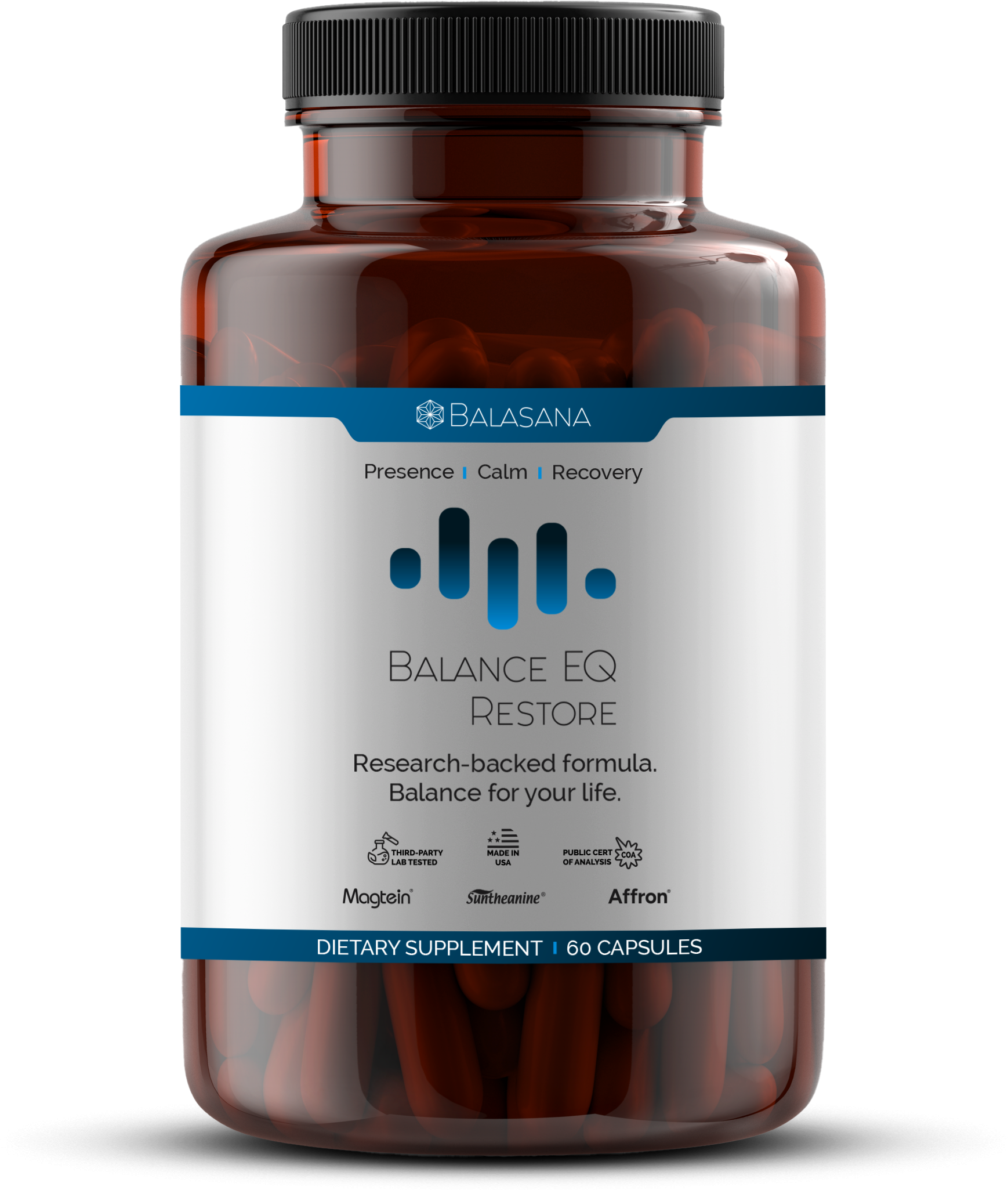
This is part of the science behind how we formulated
EQ:Restore.
Sources
Miyake M, et al. "Randomised
controlled trial of the effects of L-ornithine on
stress markers and sleep quality in healthy workers."
Nutrition Journal, 2014.
DOI
|
PubMed. Key finding: L-Ornithine significantly reduced serum
cortisol and improved sleep quality vs. placebo in
office workers over 8 weeks.
Hidese S, et al. "Effects of
L-Theanine Administration on Stress-Related Symptoms
and Cognitive Functions in Healthy Adults."
Nutrients, 2019.
DOI
|
PubMed. Key finding: Improved verbal fluency, executive
function, and sleep quality vs. placebo.
Zoccola PM, et al. "Rumination
predicts heightened responding in cortisol."
Int J Environ Res Public Health, 2017.
DOI
|
PubMed. Key finding: Work-related rumination predicted
elevated evening cortisol independent of workday
stress.
Osterberg K, et al. "Cognitive
performance in patients with burnout." Stress,
2012.
DOI
|
PubMed. Key finding: Burnout associated with elevated
evening cortisol and impaired cognitive recovery.
Sonnentag S, Fritz C. "The Recovery
Experience Questionnaire."
J Occupational Health Psychology, 2007. Key
finding: Psychological detachment from work is distinct
from merely stopping work, and is required for genuine
recovery.
These statements have not been evaluated by the Food and
Drug Administration. This product is not intended to
diagnose, treat, cure, or prevent any disease.